When working on projects there is inevitably some waste paper. So we were delighted when our offcuts have been transformed into Fröebel Star Decorations (Fröebelstern) by two creatives in Malvern. Here they explain why they wanted to do work with us.
Where Did the Idea Come From?
We love upcycling and the idea of cradle to cradle manufacturing. Turning waste into a raw material is more energy efficient too. Our original christmas decoration idea involved using offcuts of baize. However we changed our mind when we discoved how to make Fröebel stars. So we started to scour the internet for print finishers. We found Card Couture after looking for an ethical print finisher, discovering them because they are passionate about cradle to cradle manufacturing too. As it turns out, when we made contact with them, they make a point of keeping their offcuts rather than send them to recycling.
To make Fröebel star decorations you need to use relatively long strips of paper, the more colourful it is the better. Card Couture had just what we required as a result of their judicious use of their guillotining process.
From Waste to Fröebel Star
We start by grading the paper as it comes in varying widths. Sometimes when paper stacks are trimmed the strips have a taper, so we have to make sure each strip has an even width, which is vital to ensure the star works out.
Cat inspecting paper
Once we have graded the pieces of paper and our cat has quality controlled the box of paper, we make sure the width and length of each strip is compatible.
The wider the strip of paper, the longer it needs to be to make a star. The joy of using upcycled paper offcuts, is that the widths of paper available are so variable, meaning the stars end up being different sizes once made.
On to a Christmas Tree
In Malvern we have a fantastic Organic and zero waste shop called Green Link, who have kindly agreed to stock them for us, so what was once waste can bring a bit of Christmas joy and cheer.
Completed Fröebel Star Christmas Tree, Table or Window Decorations
The Fröebel stars naturally make great tree decorations, but they’re also fantastic as table and window decorations too.
As a craft print finisher we use traditional materials and equipment, combined with hand-finishing to achieve elegant results for our clients. Yet we’re not afraid to use modern technology along the way. One tool we use in the briefing stage, is CAD to create visuals to aide our client’s decision making process.
Why Use CAD to Create Visuals?
Most design houses will use mockups in one way or another to present their designs and layouts to a client. Often this involves using generic mockups available from libraries and then applying the design or treatment to them. Often this is done using both Adobe Photoshop and Illustrator, or increasingly Affinity’s Photo and Designer software.
Illustrator or Affinity Designer are the best tools for the job of creating logos or creating refined typography. Likewise Photoshop or Affinity Photo are ideal for creating photo-realistic mockups of the design.
These tools alone are great for presenting ideas that are going to be produced using standard A size formats with four-colour print process.
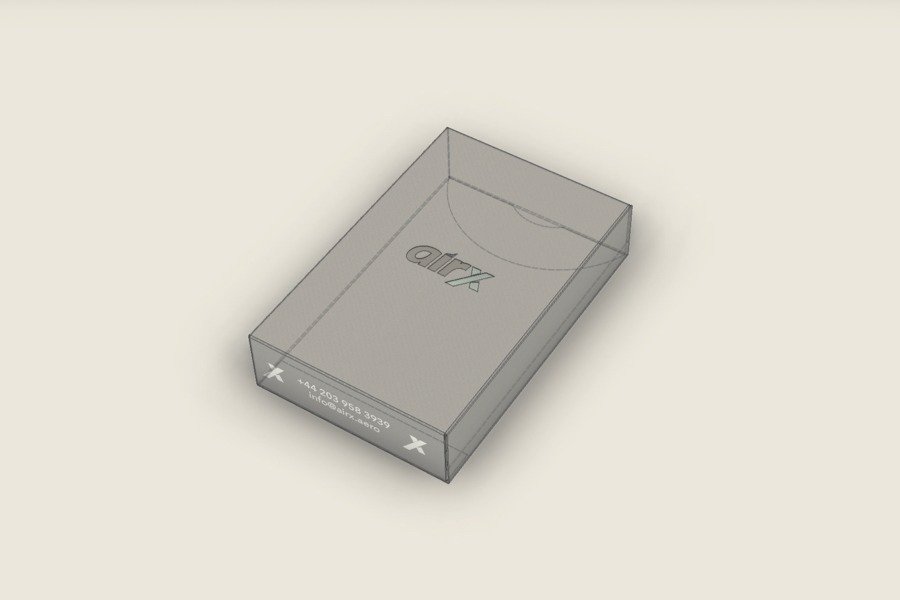
Because pressure based printing allows a gamut of textured and coloured papers to be used, CAD allows the nature of these materials to communicated to the client far easier. In short using CAD to create visuals, is ideal for realistically exhibiting the properties of non standard print materials and art papers.
The Many and Varied World of Art Papers
When creating work for clients, there are three paper merchants we tend to specify paper from, whose ranges include a myriad of papers with different colours, textures and weights. As these papers are so varied and have stunning, eye-catching properties, simply specfiying a paper and providing a flat sample, can not do some of these papers justice.
Using 3D modelling and rendering allows the client not only to see their design on a custom box, business card or compslip, but to get a feel for how each piece will actually look and feel.
This is achieved by applying actual paper samples and texture maps to a 3D object. CAD or 3D modelling also allows us show the finer detials of pressure based printing, by embossing or debossing the surface of the 3D object.
Art papers and their textures can be displayed in details using CAD and 3D rendering
Using 3D modelling is a huge benefit to us and the client. For us it allows us to see if a particular combination of materials and papers will work together visually. It is a cost effective way for us to create rapid prototyping and get the conversation started with clients who simply don’t realise what’s available.
For the client 3D modelling and CAD gives an accurate representation of their project, before any firm budgetry commitments have been made. This allows re-briefing or for different paper and foil combinations to be previewed, before production and spending commitments are made.
With the quality and integrity of modern 3D rendering, being able to be achieved on the modest desktop or laptop computers, photorealisitic mockups can be realitively quickly created.
For example to create a thicker weight board you could opt for duplexing (the lamination of paper on to board). We use this technique quite a lot as it means colour can be used without resorting to offset printing.
Laminating a coloured sheet onto a piece of cardboard can create an interesting looking “sandwich edge” but you might not want that look and prefer the edge to be a solid colour, either the same colour or a contrasting hue to the papers used for the fronts and backs of the business card. Gilt edging the cards can overcome this.
Get Creative Colour Coordination
The foils available for edge gilding are highly varied. Not only are the obvious metallic colours like gold and silver, available, but also a variety of other metallic colours too.
Different papers can be used for each side of the card adding texture and interest
Because we specialise in pressure based printing techiques, we can print your details onto the surface of the card using the same colour foil – using a process called hot foiling. This really ties the look of the business card together in a highly impactful and aesthetically pleasing way.
Choose Gilt Edged Business Cards
If you want to take advantage of our edge gilding service (other companies who offer this service do!), then be sure to get in touch with us as we’d love to produce your business cards and make them absolutely stunning.
Contact Us
Share on twitter
Share on facebook
Share on pinterest
Share on stumbleupon
Share on google
Share on tumblr
Share on linkedin
Gilt Edged Business cards are an impressive way to make a connection with new contacts. Rather than just a piece of card with your name and details on, choosing to gilt edge your business cards not only makes a statement, but you’ll be giving to future prospects a card they’ll want to keep. This means more mindshare for you in your future customer’s or client’s eyes.
What is Gilt Edging?
Gilt Edging or Edge Gilding is the application of a metallic foil onto the edge of paper or card. When done correctly the finish is flawless to the point that a stack of Gilt Edged business cards can look like one solid block of metal.
Design Considerations for Gilt Edged Business Cards
Edge gilding on business cards is most impactful if the board used is thick, so when seen individually the gilding still makes a noticeable impact.
For example to create a thicker weight board you could opt for duplexing (the lamination of paper on to board). We use this technique quite a lot as it means colour can be used without resorting to offset printing.
Laminating a coloured sheet onto a piece of cardboard can create an interesting looking “sandwich edge” but you might not want that look and prefer the edge to be a solid colour, either the same colour or a contrasting hue to the papers used for the fronts and backs of the business card. Gilt edging the cards can overcome this.
Get Creative Colour Coordination
The foils available for edge gilding are highly varied. Not only are the obvious metallic colours like gold and silver, available, but also a variety of other metallic colours too.
Different papers can be used for each side of the card adding texture and interest
Because we specialise in pressure based printing techiques, we can print your details onto the surface of the card using the same colour foil – using a process called hot foiling. This really ties the look of the business card together in a highly impactful and aesthetically pleasing way.
Choose Gilt Edged Business Cards
If you want to take advantage of our edge gilding service (other companies who offer this service do!), then be sure to get in touch with us as we’d love to produce your business cards and make them absolutely stunning.
Contact Us
Share on twitter
Share on facebook
Share on pinterest
Share on stumbleupon
Share on google
Share on tumblr
Share on linkedin
Our approach to box making and print finishing is informed by the principles of Cradle to Cradle manufacturing. In this article we explain why we chose to adopt this design principle and the benefits of doing so on the environment.
What is Cradle to Cradle Manufacturing?
Cradle to Cradle is an environmentally low impact, design and manufacturing philosophy. Where the end product is made in such a way that it can dismantled into its constituent parts, ready to be used again.
Furthermore the cradle to cradle principle looks at the raw materials that go in to the system or product to be made and how they themselves are made. The ultimate goal of this manufacturing principle is to create a product that is inherently good or beneficial for the environment. For example the water coming from a factory leaves cleaner than it went in.
Environment First Box Making and Print Finishing
All of us at Card Couture are highly committed to reducing our individual impacts on the environment. We put ethics and the environment at the heart of our lives and our business. This is why we decided early on, to chose Trees for Life as our charitable partner and each job we do, helps to grow our Trees for Life grove in the Caledonian Forest. This is also why we have chosen to run our business using electricity from 100% renewable sources and what led us to start adopting cradle to cradle priciples into our production and design specifications.
Using Fewer Raw Materials
As a traditional box maker, our process of box making and print finishing, helps to minimise the use of environmentally damaging materials. As we only offer impression printing, we don’t have the same impact as if we were offering offset ink printing.
On of our specialisms is in Paper over Board box construction, which uses only three raw materials; Box board made from from wood pulp, a natural bio-degradable adhesive and a covering paper. Boxes made in this way are 100% recyclable as there is no cross contamination of incompatible materials.
Using fewer materials can also reduce the cost of the job overall. So not only is a reductionist approach good for environment it can also good for budgets too!
What About Hot Foiling?
We still have a way to go before we have figured out how to be fully cradle to cradle, as one of our most popular processes – Hot Foiling – does regrettably reduce the recyclablity of paper as it combines two materials together: paper and foil.
There is however a simple solution if you want make your next piece of branded packaging environmentally aware and fully recyclable. By leaving the foil out and blind embossing or debossing paper can add branding in a beautifully subtle way, that’s both understated and classy. Better yet choosing blind embossing or debossing retains the full recyclablity of the papers used.
Luxury Packaging – Less is More…
As with everything today, there is so much choice available when considering your next luxury packaing project. From papers, to special print finishes and even down to the method of closing the box.
German architect Ludwig Mies Van Der Rohe was famous for the aphorism “Less is More”. Mies Van Der Rohe understood that what you leave out of a design has more impact than its inclusion. By only including the bare minimum, the elements included have the most impact.
When thinking of your next luxury packaging project, try to avoid wanting to use lots of materials or finishes, and embrace a less is more approach. As when it comes to helping the environment and creating luxurious packing, using few materials is by far the best and most impactful thing that you can do.
Do You Want Environmentally Friendly Luxury Packaging?
If the answer is “yes”, then be sure to get in touch with us as we’d love to work on your project and help you realise your more environmentally friendly packaging.
Contact Us
Share on twitter
Share on facebook
Share on pinterest
Share on stumbleupon
Share on google
Share on tumblr
Share on linkedin
This website uses essential cookies only, and these are to enable our website to function correctly. Your data is safe with us. To see how we use cookies, please view our cookie policy page to find out more. Accept
Privacy & Cookies Policy
Privacy Overview
This website uses cookies to improve your experience while you navigate through the website. Out of these, the cookies that are categorized as necessary are stored on your browser as they are essential for the working of basic functionalities of the website. We also use third-party cookies that help us analyze and understand how you use this website. These cookies will be stored in your browser only with your consent. You also have the option to opt-out of these cookies. But opting out of some of these cookies may affect your browsing experience.
Necessary cookies are absolutely essential for the website to function properly. This category only includes cookies that ensures basic functionalities and security features of the website. These cookies do not store any personal information.